
Msgr. Moises Andrade during the Octave Within Christmas 2007 elevating the Body of our Lord
 Fr. Joseph Skelton elevating the Body of our Lord.Fr. Joseph Skelton elevating the Body of our Lord.
A solemn high mass in Latin will highlight the fiesta of Mandurriao parish on January 23, 2008. Rev. Fr. Esperidion Celis, parish priest of Mandurriao, said he wrote Pope Benedict XVI to seek his blessing of the significant reliThanks to Condotiere for this wonderful news.gious undertaking.
Celis said the idea of holding the solemn high mass in Latin is in support of the Holy Father's decision to bring back and give wider use of the Latin mass according to the 1962 Rite approved by the Papal Moto Proprio "Summorum Pontificum."Celis said it would be the first time since the 1960s that the Latin mass will be conducted in the Archdiocese of Jaro and even in the entire country. [He could mean that it will be the first time since the 1960s a Latin Mass in Jaro will be offered and celebrated freely by priests without any permissions or indults needed due to the clarification of the Vicar of Christ. After all, Summorum Pontificum is really intended for priests.]
The Latin mass will be held after the 2:00 p.m. procession around the plaza on January 23.
The mass, which will be officiated by Msgr. Juanito Tuvilla, will have a Gregorian Chant and traditional Christian hymns like Mozart's "Ave Verum" and Franck's "Panis Angelicus", as well as a polyphonic rendition of the "Messe Solenelle de Ste. Cecile" by Charles Francois Gounod.
Celis said they have invited parishioners from as far as the province of Capiz and Antique to witness the holding of the Latin mass. They have also invited students of Catholic schools in the city to attend the celebration to give them the chance to experience the 1962 Rite in Latin.
 This Friday, 25th of January, the pilgrim relics of the Little Flower, St. Therese of the Child Jesus, will be visiting the Diocese of Cubao. She will arrive at 8 am at the Immaculate Conception Cathedral, the seat of the bishop of Cubao, where she will be welcomed by Father Michell Joe Zerrudo.
In a charitable, clear manner, explain what you see here. What gratifies you about the action in the photograph. What bothers you. Those who see it as beautiful, explain why and its deeper relation to your Catholic faith. Those who are bothered by it or mystified by it, explain why.

The other day Amy Welborn posted a thought-provoking question involving this picture, depicting either a Mass of the Extraordinary Form or a Novus Ordo Mass celebrated Ad Orientem:
Amy asked people for their reactions to the photo, and the reactions were themselves thought-provoking and revealing. What they seem to reveal is something I have noticed before in many of the negative reactions to Pope Benedict's Motu Proprio and to the Extraordinary Form of the Mass, otherwise known as the "Tridentine" rite. What is apparent to me is that many of the objections are ideological rather than theological or spiritual. Here are a list of some of the words and phrases used in the negative reactions to the photo, or other objections and complaints about Summorum Pontificum and/or the Extraordinary Form that have appeared in the media since last July:
"too complicated"
"put off by all males in the sanctuary"
"a period piece…"
“stuffy,”
“elitist”
“inaccessible”
“extreme"
“antiquated”
"medieval trappings"
"nostalgia"
"hierarchical"
"staged"
"Latin is a dead language"
"the priest has his back to us"
"a step backward"
"exclusionary"
"sexist"
"liturgy should be simple"
"clericalist"
"passive"
These words and phrases, and others similar to these, characterize much of the opposition to and complaints about Summorum Pontificum and the resurgence of the Extraordinary Form. And what is remarkable is that none of these words and phrases are, properly speaking, either theological or liturgical. Rather, they are ideological. And they illustrate that the post-conciliar liturgy, at least in the United States, has been invested with a rather heavy ideological burden.
I think that the ideologies represented by these terms can be roughly divided into three categories. They are:
(a) Egalitarianism or Democratism
(b) The Ideology of "Progress"
(c) The Ideology of "Authenticity"
The first ideology, egalitarianism, can be seen in such terms as "stuffy", “elitist”, "hierarchical", "the priest has his back to us", and "clericalist". Egalitarianism, of course, is the ideology that seeks to level all differences and distinctions, and asserts radical equality. The problem is that Catholic liturgy is intrinsically "unequal". Liturgy is about we humans, who are not God, worshipping God, who is God. Sorry to belabor something that should seem obvious, but, unfortunately, many have worked for the last 30 years to obscure that obvious fact. Catholic Liturgy is intrinsically hierarchical: In it God comes to us in an act of condescension, witnessed by the angels and saints who are quite literally above and beyond us, through the ministry of a priest who is at the time of the Eucharistic Sacrifice alter Christus. One commenter at Amy's asserted that at Mass we "no longer have an alter Christus". If that's the case, then we no longer have a Mass or Eucharistic Sacrifice; we have something else. Fortunately, the commenter's assertion is wrong: Both Vatican II's Constitution on the Church (Lumen Gentium) and on the Liturgy (Sacrosanctum Concilium) make clear that the priest offers the Eucharistic Sacrifice "in the person of Christ" (in persona Christi) and that his priesthood differs from the common priesthood of the faithful "in essence and not merely in degree". In other words, the priestly essence and action in the liturgy is hierarchical. To complain that the Mass is "hierarchical" is to complain of a tautology.
But there has been a great effort to downplay and even eliminate the hierarchical nature of the liturgy in recent decades. There has been an attempt to "horizontalize" the liturgy: hence all the 70's and 80's talk of the liturgy being a "celebration of community". The mindset created by such rhetoric can be seen in the complaints that in the EF, or the Novus Ordo celebrated ad orientem, the priest has his "back to the people". Of course, the assumption inherent in that complaint is that priest "should" be facing us, that is paying attention to us. Nowadays, when some people see a celebration ad orientem, they are "put off". I submit that this is because they have been subtly led to think that the liturgy is "about" us. A posture in in no way mandated by either the liturgical teaching of Vatican II or any post-conciliar document has been invested with an ideological meaning (itself nowhere taught by the Council), and has deformed the liturgical sensibilities of many of the faithful. Our expectations of the liturgy have been formed not by authentic Catholic theology and piety, but by the ideologically constructed categories of the prevailing culture.
The second category of terms can be classified as belonging to the ideology of "Progress". This ideology can be seen in such words and phrases as "a period piece…", “antiquated”, "medieval trappings", "nostalgia", and "a step backward". The ideology of Progress asserts or implies that we now necessarily know more and understand things better than our forebears, and that what is past is necessarily inferior to what is present. The phrase "the past has nothing to teach us" could well summarize this ideology. In the Church, this ideology has driven the "hermeneutic of discontinuity", which operates from the assumption that the Pre-Conciliar Church and Faith are different from the Post-Conciliar Church and Faith. But, of course, as C.S. Lewis pointed out in his essay on "The Myth of Progress", this point of view is absurd on its face. What is true yesterday will be true tomorrow. The time of day has nothing to do with it. Or, as Pope Benedict put it, "what earlier generations held as sacred, remains sacred and great for us too...". The fact that something is old does not mean that it is therefore meaningless or irrelevant. It merely means that it is old.
Finally, the third category of negative terms falls under the heading of offenses against the ideology of "Authenticity" or simplicity. This ideology consists in the atittude that what is most "authentic" or meaningful is that which is simple. This ideology can be seen in words or phrases such as "too complicated", “inaccessible”, "staged", and ""liturgy should be simple". I have heard this attitude expressed in the assertion "surely God meant religion to be simple". Well, just why should we think that? The universe that God made is certainly not simple. I don't hear people complaining "astrophysics should be simple." Well, astrophysics is one way of approaching an understanding of a complex reality, and religion is a different way. Why one should be any simpler than another is in no way obvious. And why the worship (liturgy) of our religion, which puts us into contact with the ultimate Reality, should be "simple", is also in no way obvious.
It seems to me that, at worst, this desire for "simplicity" is but one step removed from indifferentism. For the indifferentist usually wants, in the name of "simplicity", to put aside all those complex doctrines and teachings, and get down to a common "core" which we all can agree on. "We really all believe the same thing", is the claim. Well, we don't. And that which is fully and distinctively Catholic is expressed in a celebration of the liturgy of the Extraordinary Form, or in the Novus Ordo when it is celebrated in manner which is in continuity with the full liturgical Tradition of the Church. It seems to me that, at bottom, at least some of the complaints about "simplicity" are in fact veiled complaints or difficulties about what is in fact authentically Catholic.
And the complaint that the liturgy is "inaccessible" seems to me especially to miss the point. We are talking about approaching the infinite and ineffable Mystery of God. That is inherently "inaccessible". Not "incomprehensible", to reiterate a point made by Frank Sheed. But does anyone really expect that God coming among us and uniting us to Himself, and giving us His very self as food and drink, should somehow be "accessible"? The liturgy is mystagogical: that is, it leads us into a Mystery. We can penetrate that mystery more fully, and come to know it more deeply, but it will never be "accessible" this side of Heaven. To want a liturgy that is "accessible" seems to me to want to put God into a box of our own making; to create a comfortable, tame, suburbanized God that doesn't challenge, doesn't make us uncomfortable. And come to think of it, doesn't that explain much of our parish liturgies over the past 30 years: tame, comfortable, suburbanized?
At best, the complaint that the EF is "too complicated" reveals a taste. And, as the saying goes, "de gustibus non disputandis". If your taste is for simple liturgies, that's fine. At many parishes the early Sunday Mass is the "simple" one: minimal music, quiet, etc. I like such liturgies myself on occasion. But recognize that it's a taste, and don't try to absolutize it into a liturgical principle. Let's be honest, though, is there really anything "simple" about many parish Masses, which involve a "cast of thousands" of Extraordinary Ministers, Lectors, Commentators, a "music ministry" group with all manner of keyboards, guitars, mixers, electronic equipment, etc.? If you prefer a Mass like that, your complaint isn't really about simplicity, it's about something else.
Though unintended by the Council fathers, and, I will presume, the Consilium that assembled the Novus Ordo liturgy, the post-conciliar liturgy has been invested with a great deal meaning and import that has little to do with the Catholic Faith and very much to do with certain ideological trends in American culture. And those ideologies are in large part antithetical to the Catholic faith. That has led to the phenomenon we witness today in many parts of the Church: the liturgy has been put to work against itself. And we will only have true progress (progress that is, toward holiness and deeper union with Christ) and reform when we recognize the ideological burden placed on the Novus Ordo liturgy and remove it.

 Entrance Procession
 Entrance Procession (viewed from above)
 Asperges (Blessing)
 Reading of the Epistle
 Incensing before the Gospel
 Incensing during the offertory
 Elevation of the Sacred Body of our Lord
 Elevation of the Precious Blood of our Lord
 Minor Elevation
 Celebrant's Communion
 Communion of the Faithful
 Father Jojo blessing the chalks
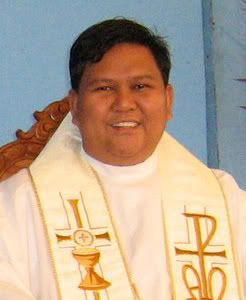 Rev. Father Abraham P. Arganiosa, CRS, from Sorsogon City, Province of Bicol, is preparing himself to celebrate the Holy Sacrifice of the Mass according to the Missal of Blessed Pope John XXIII.
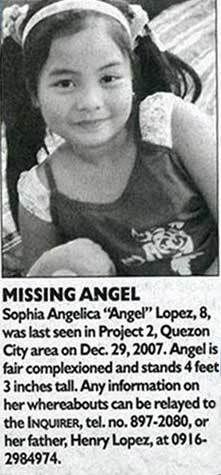
A faculty member of the Philippine Center for Creative Imaging (PCCI), Mr. HENRY LOPEZ, has sent an appeal for help in locating his daughter ANGELICA, missing since December 29, 2007 What a way to start the New Year for her family. In case you sight the child, please relay the information to Mr. Lopez via the contact information provided below: Let us pray that she is safe and found soon unharmed. Thank you. -
Vatican, Dec. 31, 2007 (CWNews.com) - The Vatican will soon issue a new document clarifying the terms of Summum Pontificum, Cardinal Tarcisio Bertone (bio - news) has revealed.
Confirming reports that have circulated around Rome in recent weeks, the Vatican Secretary of State told the Italian weekly Famiglia Cristiana that the Ecclesia Dei commission will issue instructions to "clarify the criteria for the application of the motu proprio" in which Pope Benedict XVI (bio - news) broadened access to the traditional Latin Mass.
Cardinal Bertone said that the new document was needed because there have been some "confused reactions" to the motu proprio. In fact some Vatican officials-- most notably Archbishop Malcolm Ranjith, the secretary of the Congregation for Divine Worship-- have energetically criticized bishops who have failed to accept the papal directive.
Cardinal Bertone took a more conciliatory approach to the disputes that have arisen in the aftermath of the Pope's move to restore the traditional Mass. The Italian prelate told Famiglia Cristiana that had been widely misinterpreted, and the new instruction from the Ecclesia Dei commission would attempt to clear up misconceptions.
"Some people have charged that the Pope was rejecting the Council's [Vatican II] teaching," Cardinal Bertone told the Italian magazine, emphasizing that this interpretation is completely unfounded. At the same time, he also dismissed the theory that Pope Benedict hopes to replace the Novus Ordo Mass, making the "extraordinary form" the single liturgical usage of the future. That is equally inaccurate, the cardinal said.
Cardinal Bertone did not indicate when the new liturgical directive would appear. Some Vatican-watchers believe that the instruction from Ecclesia Dei will appear within a matter of days; others have said that it could be several weeks before it is published.
As of late, the splendor and beauty of the Sunday and Feast-Day Masses at the Lord of Divine Mercy Parish have been greatly enhanced thanks to the following:
1) A new cantor who sings the Gregorian chant -- melismas and long "a"s and "o"s and all -- of the propers of the Mass (Introit, Gradual, Alleluia, Offertory and Communion) instead of the recitative that had been previously employed. (Yes, we finally have real Gregorian chant! And in this coming year, the TLM community is committed to finally form a choir or "schola" to sing Gregorian chant.)
2) The Christmas and January 1 Masses where celebrated with all the works -- incense, master of ceremonies, torchbearers, etc. The Tridentine form of incensing the altar -- with its multiple genuflections by the priest and servers -- is really so beautiful. (No, it is not the same as in the Novus Ordo. Not that I'm attacking the Novus Ordo, which I also respect and which I attend on weekdays, but you have to see the way it's done in the TLM to know what incensing really looks like.) Hopefully, January 6 will be celebrated with the same intensity and solemnity.
I would like to add here that Fr. Jojo Zerrudo's sermons are really outstanding, and deserve to be podcasted. If you want to go to a Mass where the priest really delves deep into the Biblical readings and their doctrinal and moral meanings, go to Lord of Divine Mercy. Fr. Zerrudo shows that priests don't have to crack jokes (although he is funny at times) or try to be "relevant" in order to communicate the meaning of the Word of God to the congregation. (By the way, his sermons are long -- 30 minutes -- but very substantial, and the congregation doesn't fall asleep).
(...)
So, if you would like to see liturgy the way it was done in the old days, sung to traditional chant -- please do come on January 6!!!


 more photos from hallowedground
Hello,
There will be a Latin Mass celebrated at St. Jerome Emiliani Parish in Alabang, beside Alabang Town Center, 11pm on Christmas Eve. Nope, it's not what you think it is. It's just a Novus Ordo Missae celebrated in Latin. The parist priest Fr. Grato Germaretto, an Italian priest told me that it is a "Missa Cantata" with Gregorian chants (of course it is). He also told me that his parish has been observing the tradition of celebrating (Novus Ordo) Mass on Christmas Eve, in Latin for the past 5 years. I asked him whether he would consider celebrating Latin Mass in the Tridentine Rite after all the Holy Father's Summorum Pontificum is in full-implementation, he replied, "maybe next year".
I happened to notice that there is a significant clamor for the Tridentine Mass here in the Diocese of Parañaque. Even some Misa de Gallos, as reported by friends, were celebrated in semi-Latin Novus Ordo Masses, in “Missa Cantata” with Gregorian chants using traditional melodies. In the Presentation of the Child Jesus Parish (inside BF Homes), the officers there told me that there were a lot of parishioners requesting for the said mass. My girlfriend who attends a Simbang Gabi 4 am Mass, told me that at one time she woke-up realizing the Gloria being sung the way it is sang in Divine Mercy Church, plus the Credo, Pater Noster, and the Agnus Dei, all in Latin. It maybe understandable that Novus Ordo Churches are easing the transition and the implementation of Tradition, let us just hope that it wouldn't take a year(s) long, at least here in my Diocese. Let us continue the restoration of Sacred Tradition back into the Novus Ordo Churches.
Instavrare Omnia In Christo,
Armand

The picture is definitely pre-Vatican II.
Looking at it, I can pick out the following details which help me date this picture:
1) There is no free-standing altar. Only the ad orientem high altar occupies the sanctuary
2) The communion rail is covered with an elaborate houseling cloth, which was obligatory in the Mass until made optional by Bl. John XXIII in 1961
3) The pulpit midway down the church is still in use, and is apparently decorated with fine fabrics
3) ALL the women are wearing veils, and the veils are predominantly black, which is really the tradition (only unmarried young women wore white veils; black veils are for the married and widowed)
4) The catafalque in the middle of the church is very tall and elaborate, something not often seen even in contemporary traditionalist liturgies. The candles around it are also very tall.


